AI Agents vs AI Chatbots: What’s the Difference?
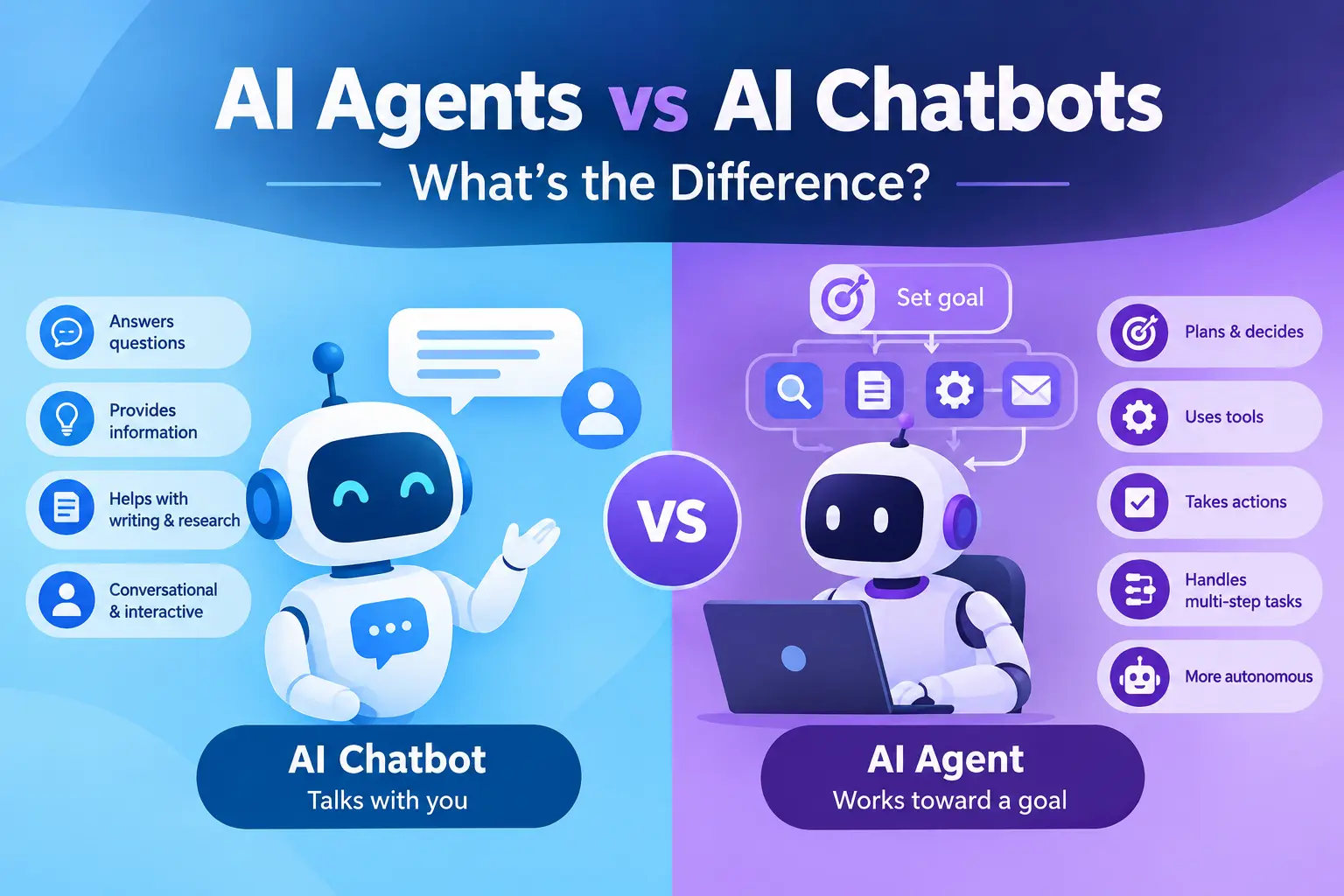

Artificial intelligence is changing the way people interact with software. Two terms you’ll hear frequently are AI chatbots and AI agents. While both use artificial intelligence to understand and respond to users, they are designed for different purposes.
So, what exactly is the difference between AI agents and AI chatbots? Let’s break it down in simple terms.
What Is an AI Chatbot?
An AI chatbot is a software application designed to communicate with users through text or voice. It uses natural language processing and large language models (LLMs) to understand questions and generate relevant responses.
Popular examples include ChatGPT, Google Gemini, and customer-service chatbots used on websites.
A chatbot typically works in a conversational way:
User asks a question → AI processes it → AI generates a response.
For example, you could ask a chatbot:
“What are the benefits of cloud storage?”
The chatbot can explain the benefits, provide examples, and answer follow-up questions. However, it generally stops at providing information unless it has been specifically connected to external tools or actions.
Common uses of AI chatbots
- Answering customer questions
- Providing product information
- Generating content
- Explaining complex topics
- Helping with research
- Writing and editing text
- Providing basic technical support
Chatbots are particularly useful when the main requirement is conversation and information.
What Is an AI Agent?
An AI agent goes a step further. Instead of simply responding to a request, an AI agent can potentially plan tasks, use tools, make decisions, and take actions to achieve a specific goal.
For example, imagine telling an AI agent:
“Find three suitable flights for my trip, compare the prices, and prepare the best option for me.”
Depending on its integrations and permissions, the agent could search relevant systems, collect information, compare results, and complete multiple steps.
The basic process looks more like:
Goal → Planning → Tool use → Actions → Evaluation → Result
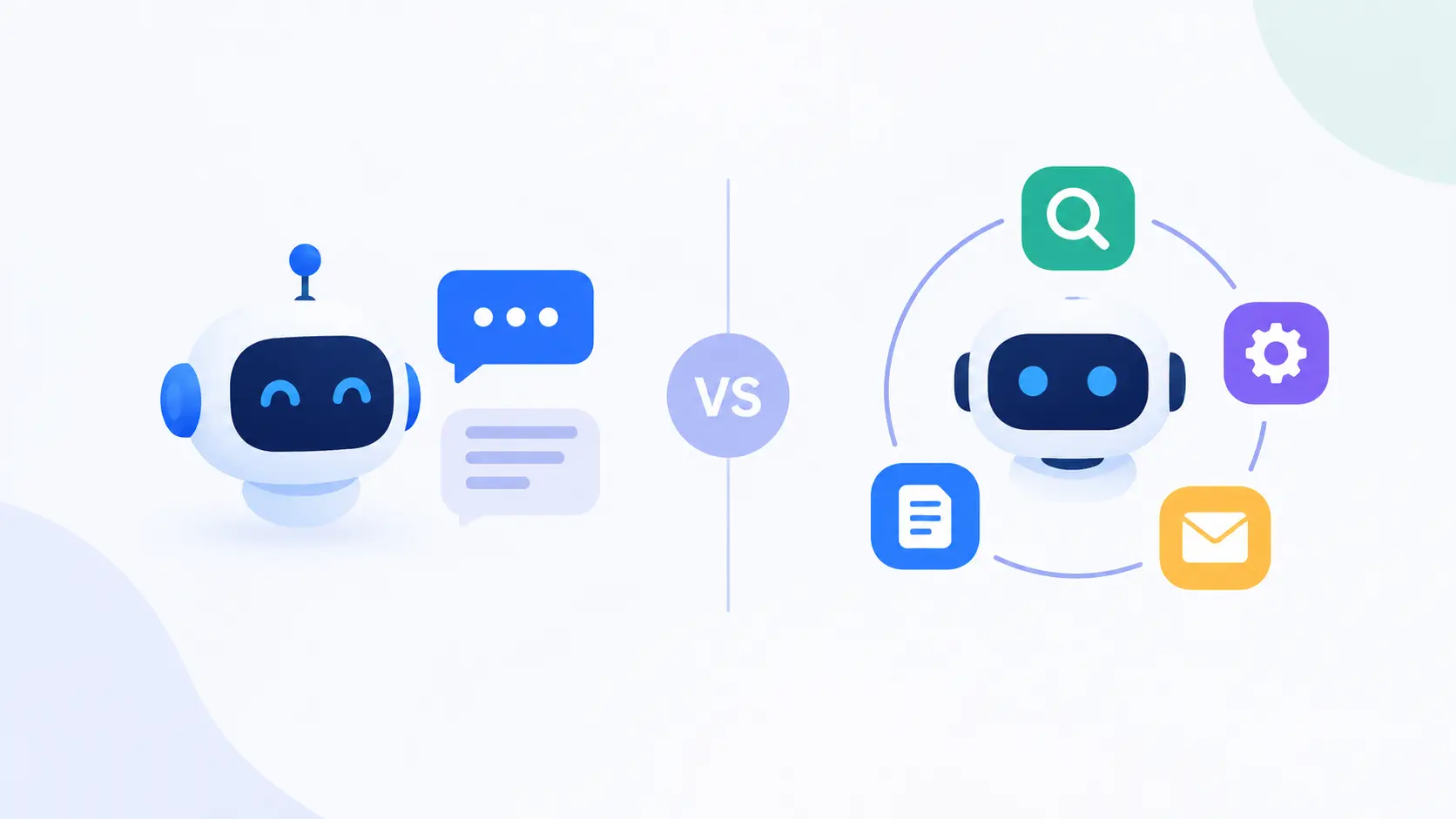
This ability to work through multiple steps is one of the biggest differences between agents and traditional chatbots.
Common uses of AI agents
- Automating business workflows
- Researching information across multiple sources
- Managing repetitive tasks
- Processing documents
- Updating databases
- Scheduling tasks
- Monitoring systems
- Supporting software development
- Automating customer-service processes
AI Agents vs AI Chatbots: Key Differences
The simplest way to understand the difference is to think of a chatbot as a conversation-focused assistant, while an AI agent is more like an action-oriented digital worker.
| Feature | AI Chatbot | AI Agent |
|---|---|---|
| Main purpose | Conversation | Completing goals |
| Answers questions | Yes | Yes |
| Uses external tools | Sometimes | Often |
| Multi-step tasks | Limited | Strong capability |
| Makes plans | Usually limited | Yes |
| Takes actions | Usually limited | Yes, with permissions |
| Level of autonomy | Lower | Higher |
However, the line between the two is becoming less clear. Modern AI chatbots can also access tools, browse information, generate files, and perform certain actions. Likewise, AI agents can include conversational interfaces.
Which One Should You Use?
The right choice depends on what you want to accomplish.
Choose an AI chatbot if you need help with questions, brainstorming, writing, explanations, or everyday conversations.
Choose an AI agent if you want to automate a process that involves multiple steps, tools, or decisions.
For example, a company could use a chatbot to answer frequently asked questions, while an AI agent could potentially handle a larger workflow such as collecting customer information, checking an internal system, creating a support ticket, and notifying an employee.
The Future of AI Assistants
AI agents and chatbots are likely to become increasingly connected. Instead of simply asking AI for information, users will increasingly expect AI systems to understand goals and help accomplish them.
Chatbots remain valuable for communication and information, while agents are expanding AI into automation and task execution.
In simple terms: a chatbot talks with you; an AI agent can work toward a goal for you.
As AI technology continues to evolve, understanding this difference can help individuals and businesses choose the right tools for their needs.